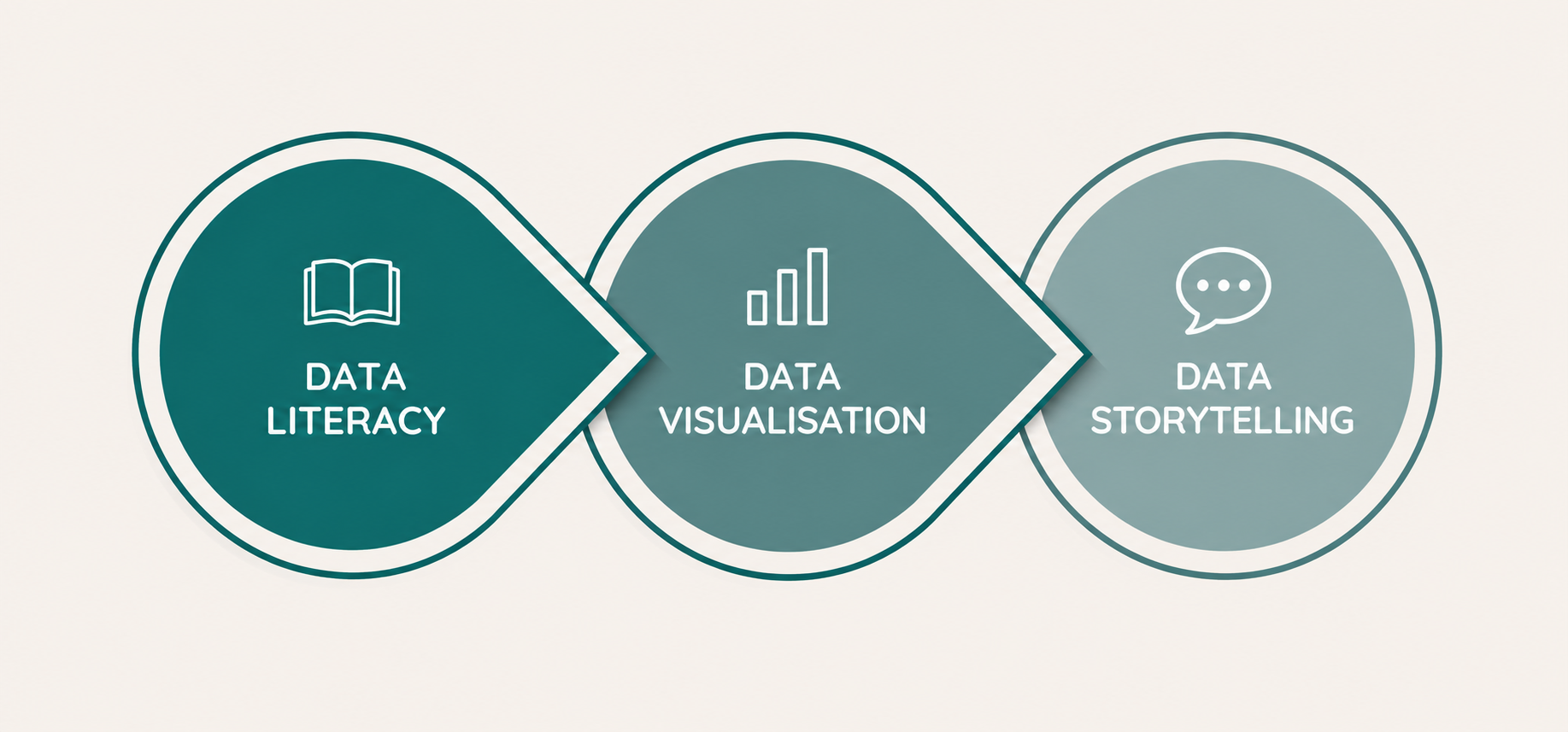
Building data storytelling skills in your team: why we all need to know the numbers
A resource for leaders who want to build employee capacity in data storytelling, so they harness the power of data to inform decision-making.
Selena is a researcher, speaker, and teacher who specialises in data storytelling. She is as passionate about helping others develop data storytelling skills as she is about growing her own understanding of the evolving ways data can help organisations flourish and thrive. For Selena, using data in a way that supports people – whether employees, clients, or leaders – is the right way to use data. Almost nothing accelerates the impact we can make in our sphere of influence like having, and acting on, quality data about the things that matter. Selena Fisk has worked with hundreds of executives, senior and middle leaders, and organisational teams to strengthen their understanding of and skills in, data storytelling. This increased capability has supported positive organisational change, not only in how individuals view data but more importantly, in how teams engage in evidence-informed collaborative decision-making.
The lost opportunity:
“Love numbers for what they tell you about real lives.”
- Hans Rosling, author of “Factfulness”.
Organisations are full of data, whether it is sales, profit, marketing costs, conversion rates, social media engagement, client or employee satisfaction, or production capacity.
Every organisation has access to different types of data and metrics, each relevant to its own context and capable of providing valuable insights into the business.
Unfortunately, a large amount of the data available within organisations is not being used to its full potential, which means middle managers, senior leaders, executives, and organisations overall are not always responding to the data as effectively as they could. Many organisations are losing business, missing opportunities to secure new business, and/or failing to adapt to emerging markets because the data is not being properly utilised.
In addition, this data, when used, is often only accessed or understood by a small group of ‘numbers’ people, such as chief information officers, chief technology/technical officers and chief financial officers. However, as we move into the era of third-generation business intelligence and data democratisation, all employees need to be able to access and use data to support their own work, as well as the work of their team, division, or the organisation as a whole. Because many employees still do not have these skills, organisations are missing a valuable opportunity to be more focused and strategic in their planning and decision-making.
The Challenge
“But I’m not a numbers person” (said by too many people, ever)
Over the past two decades, there has been significant growth in the amount of data available to us across all areas of our lives, including in the workplace. Although there is now a greater expectation for us to understand and use data in our professional roles, there has generally not been enough support and training on how to use it effectively.
While training programs exist for spreadsheet software and data visualisation, and some individuals choose to study data science or analytics at university, most employees have not been taught what this all means or the ‘so what?’ behind the data.
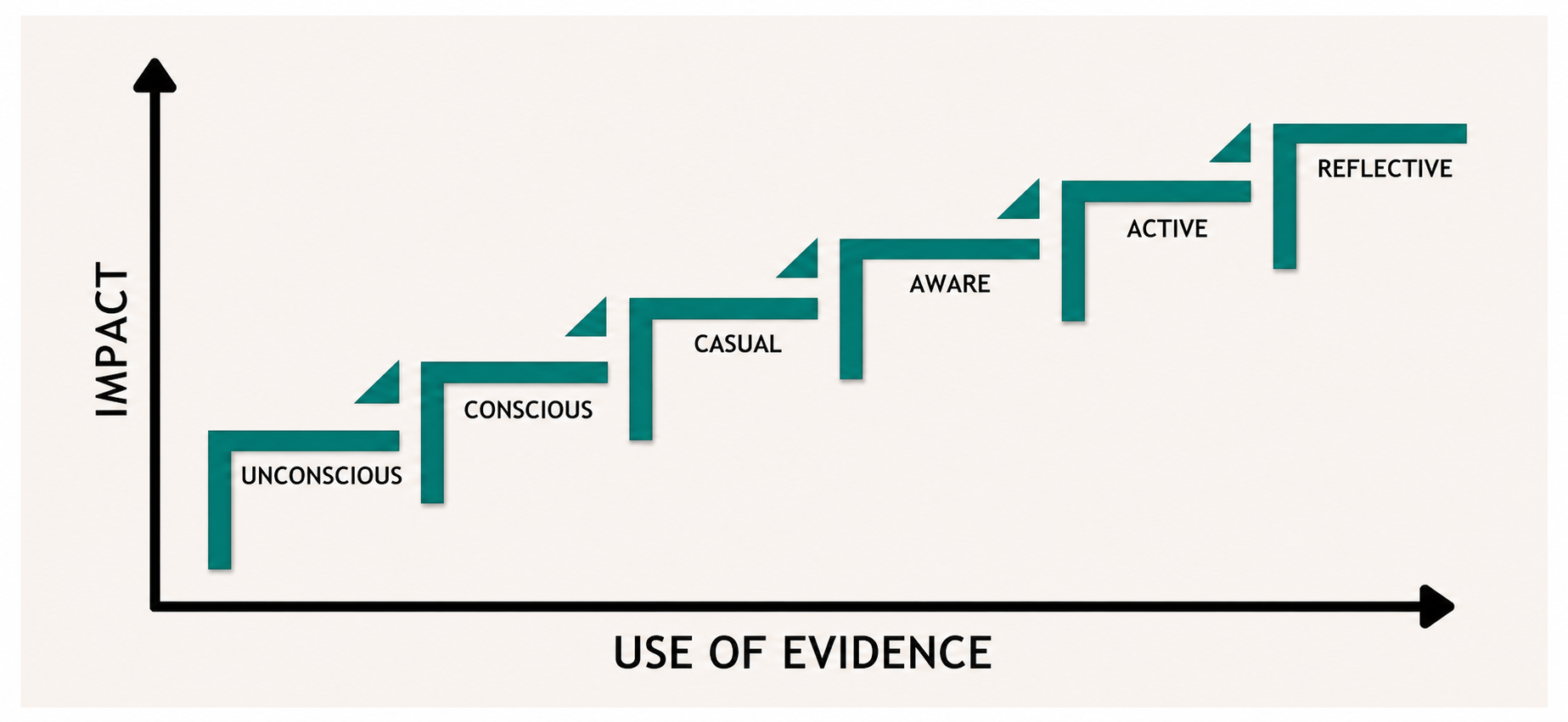
As leaders, our challenge is to help employees progress through the levels of evidence and data use, increasing understanding, application, and impact of data for both individuals and the organisation as a whole.
In the journey towards becoming more evidence-informed, everyone starts at the stage of being ‘unconscious’ about data and evidence, as shown in the first level of Figure 1. If you have staff at this level, it means data is not even on their radar, not only do they lack the skills, they are also unaware that these skills need to be developed.
When people move to the second level of being 'conscious' they recognise that data is something they need to learn more about. They know it exists, but they are still mostly unaware of the full range of possibilities and opportunities it can provide.
The challenge
“In a world that is becoming increasingly digital, data-driven, and silicon-based, we should not forget that the people living in it are carbon-based, analog, and full of feelings.” — Rishad Tobaccowala
Having a ‘superficial’ understanding of data means employees understand a few basic metrics or can interpret some data visualisations, however, they are unable to engage in deeper conversations about the numbers or their impact.
When employees reach a stage of 'awareness' their understanding begins to grow, and they start thinking about the implications of the numbers and what they could mean for themselves, their team, and the organisation more broadly.
At the ‘action’ stage, employees begin using data to guide their decisions and actions, such as adapting an offering to changing market trends, reviewing a marketing strategy, or reallocating resources based on previous patterns. If leaders can support staff in reaching the stage of 'reflection,' these employees use data to innovate, continuously adapt, and effectively evolve both their work and the organisation.
The Misconceptions
4 common misconceptions of the use of data are:
Data sits within a ‘role’ or ‘job description’ in the
Organisation, therefore, not everyone needs to know about data.
Data-driven decision making is the new normal.
Data only tells us what is going wrong.
One type of data is enough.
MISCONCEPTION #1
Data is often seen as sitting within a specific ‘role’ or ‘job description’ in an organisation, leading to the belief that not everyone needs to understand data. While it is true that many roles may directly reference data in their job descriptions, these are not the only employees who need the skills to participate in reflective and meaningful conversations about evidence. There is a growing expectation that all employees, at some level, can understand and engage in discussions around the numbers.
In organisations that already operate within the ‘3rd generation of business intelligence' this is already the norm. Piyanka Jain, an internationally recognised data science consultant, said in a discussion with MIT Sloan School of Management on data literacy in organisations, “Everybody needs data literacy, because data is everywhere. It’s the new currency, it's the language of business. We need to be able to speak that.”
It is no longer enough to assume that data is someone else’s responsibility. All employees need to understand the numbers that are relevant to their role, and they should be able to ask meaningful questions about the data and explain how it supports their decision-making.
MISCONCEPTION #2
Data-driven decision-making is the new normal.
“Data-driven” is a phrase commonly used in conversations about data; some organisations (such as Expedia) even advertise their data-driven methods. However, that term is misleading, because data should not dictate our actions, and being data-driven does not automatically make an organisation effective. As leaders, our aim should be to be data-informed rather than data-driven. This distinction is important because it means we combine the numbers with their surrounding context to guide decisions and actions.
Jeff Bezos, CEO of Amazon, is well-known for NOT being completely data-driven. He once said, “you collect as much data as you can. You immerse yourself in that data… but then make the decision with your heart”. Bezos explained that the initial numerical modelling and predictions for Amazon Prime suggested it would not succeed, but he made the decision based on his gut feeling and what he understood about the market and the emerging environment around him.
Similarly, Rishad Tobaccowala, author and chief growth officer at Publicis Group, said, "Now let me ask you this: out of the last 10 decisions you made, how many were mainly driven by data? When I’ve asked most people, it’s been fewer than three out of 10. And if the world was completely data-driven, none of us would be born. The ROI on having children is terrible.
We need to harness the power of data, but we need to be informed by it,
not driven by it.
MISCONCEPTION #3
Data only tells us what is going wrong.
Influenced by the focus on the bottom line (profit) and the way the media talks about major drops in productivity or job losses, some leaders and employees view data only as a tool for identifying problems and things that need fixing. While data can help us spot gaps in the market, understand reasons for lost business, or identify declines in productivity and guide our attention towards possible areas of focus, it also provides a powerful opportunity for celebration and recognition.
If an employee achieves their biggest sale so far, the business experiences the highest growth in its history, you secure a major new client, or a marketing campaign for a new product performs extremely well, that data should be used to celebrate with staff and recognise their efforts.
Rather than falling into the trap of believing organisations only use data to identify problems and ‘fix’ things, we need to rethink its purpose so that it also reflects celebration and progress. We can shift this narrative, strengthen employee trust in data conversations, and demonstrate this as leaders.