
Selena is a researcher, educator and speaker with a strong focus on data storytelling. She is deeply passionate about helping others develop their data storytelling capabilities while continually expanding her own knowledge of how data can be used to help organisations grow, succeed and adapt in an ever-changing environment.
For Selena, data should always be used in ways that create positive outcomes for people, whether they are employees, clients or organisational leaders. She believes that few things can increase our effectiveness and influence more than having access to meaningful data and using it to make informed decisions about what truly matters.
Selena has worked with hundreds of executives, senior and middle managers, and organisational teams to strengthen their understanding of and capabilities in data storytelling. This enhanced capability has driven positive organisational change, not only in how individuals perceive and use data but more importantly, in how teams participate in data-driven and collaborative decision-making.
The challenge
The volume of data available in schools is growing rapidly, bringing with it greater expectations for educators, schools, and education systems to use this information to guide and enhance their work. However, making effective use of data is often challenging, especially as technology and data practices continue to evolve. As a result, there is rarely a clear destination, and widely accepted models of best practice or ideal implementation are limited.
For schools to successfully lead this work, authentic commitment is required across all levels of the organisation. Data can and should play a role in shaping school-wide strategic priorities, annual improvement initiatives, departmental objectives, pastoral and year-level planning, attendance and wellbeing programs, team collaboration and individual classroom teaching practices.
A significant challenge is that many educators have not received formal training in data use and have instead developed their skills independently. Furthermore, the reality that different approaches are effective for different schools and contexts at various stages of their journey adds another layer of complexity to the process.
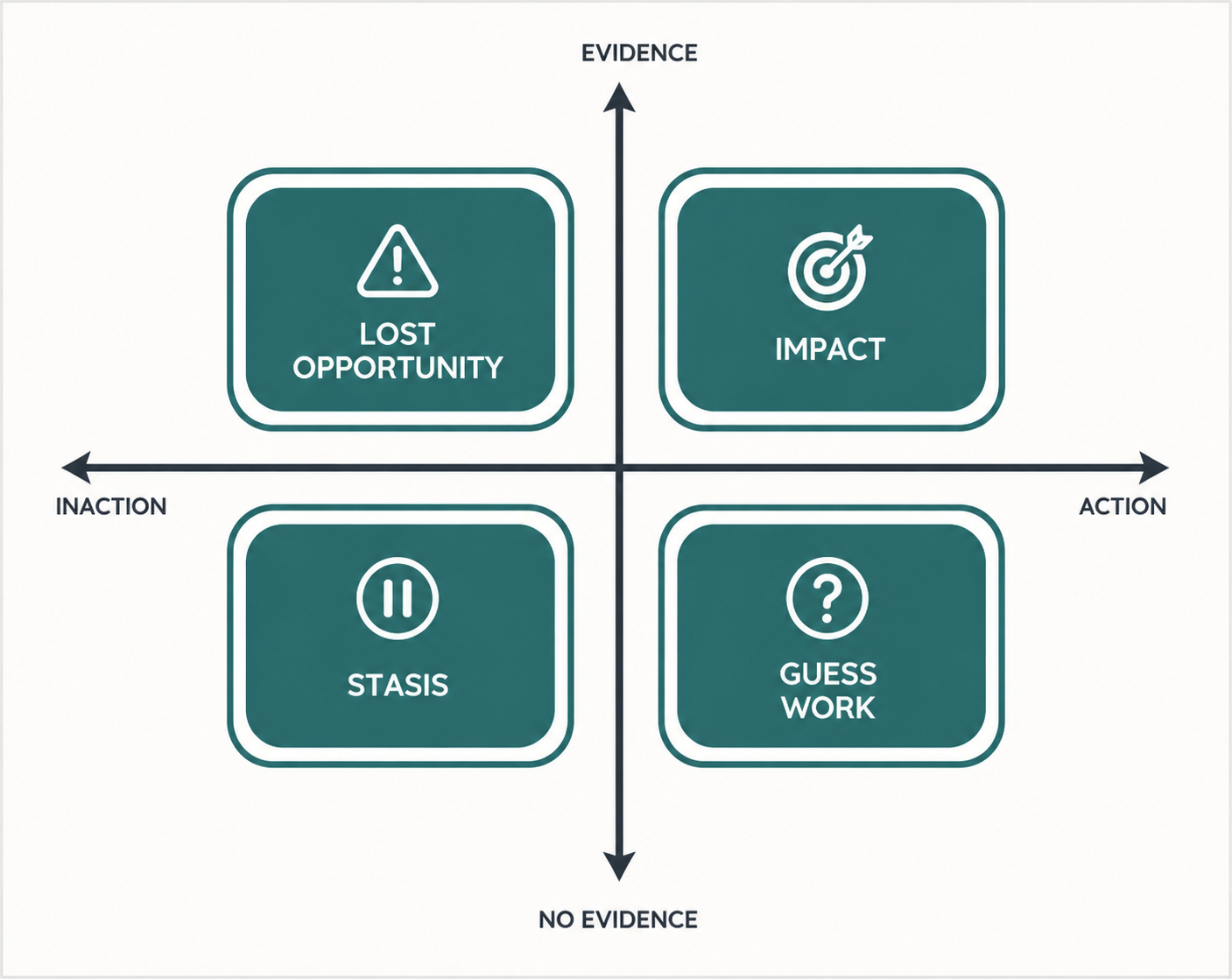
In I'm Not a Numbers Person: How to Make Good Decisions in a Data-Rich World (2022), I introduced a quadrant model that encouraged readers to consider where they currently sit in relation to their use of evidence for action, whether in stasis, guesswork, lost opportunity, or, ideally, impact. Over the past five years, these discussions have extended beyond individual reflection, with leaders increasingly asking what these same quadrants look like when applied to schools as a whole.
This paper therefore broadens the focus from the individual and explores the four quadrants through a school-wide lens. More specifically, what characterises a school that is creating impact, experiencing lost opportunity, operating through guesswork, or remaining in stasis? While our understanding continues to develop over time, there are many shared practices and characteristics among highly effective and impactful schools that are valuable to highlight and discuss.
The Four Quadrants
This quadrant model considers the amount of proof that is used in the school and the action that results from the use of evidence. As always, my focus is on using data to inform action rather than allowing it to drive decisions. A data-informed approach combines insights gained from the data with an understanding of the broader context and professional expertise, enabling more thoughtful and effective decision-making.
Evidence continuum
All schools exist at different points along the evidence continuum, ranging from those that make limited use of evidence to those that actively seek and draw upon a wide range of information. In this context, ‘evidence’ includes both internal sources, such as student data, and external sources, including research findings and insights into effective practice. Schools should make use of both what they understand about their own learners and what research indicates may be effective within their setting. These two sources of evidence are equally important and work best when used together rather than in isolation.
Action continuum
Every school is also positioned somewhere along the action continuum from taking very little action & making very little change (on the left) to being highly responsive and open to change (on the right). The success of change efforts does not impact the position here, it is about whether the site is open to learning and looking for opportunities to improve.
Stasis, guess work, lost opportunity, and impact
When viewed through this lens and assessed on balance, schools can be placed within one of four quadrants. Although uncommon, schools in the stasis quadrant make limited use of data and implement few meaningful changes. Schools operating in the guesswork quadrant are often introducing new initiatives and ideas without sufficiently drawing on school data and/or research evidence. In the lost opportunity quadrant, schools have access to evidence but are not fully leveraging its potential to guide action. By contrast, schools in the impact quadrant use evidence purposefully to inform change and strengthen their learning culture.
The Impact Quadrant
Schools that are truly evidence-informed and responsive, use data and evidence
regularly and it permeates everything that they do. They believe in the power of storytelling with data, and know how it can be transformative for young people. Data from a
range of sources (including academic, perception, wellbeing, attendance,
engagement, and learner dispositions) is collected and used formatively - it informs
the work, helps set goals and plans, and helps predict what might happen in the
future. The use of data and evidence is embedded in the culture of the school, and
Schools that are genuinely evidence-informed and responsive use data and evidence on a regular basis, and it is woven into all aspects of their work. They recognise the value of data storytelling and understand its potential to create meaningful outcomes for young people. Data from a variety of sources, including academic achievement, perception, wellbeing, attendance, engagement, and learner dispositions is gathered and used formatively. It guides practice, informs goal setting and planning, and helps anticipate future outcomes. The use of data and evidence is embedded within the school's culture, and school systems and structures enable educators to engage with and respond to the data relating to the students in their care. This includes timely professional learning and skill development when new technologies and/or data sets become available. Educators consider data through both achievement and growth lenses, and there are intentional opportunities to celebrate positive outcomes and progress with both staff and students. School technology supports effective data use across all levels, while inquiry and action research cycles assist with ongoing review and refinement. The school maintains a data plan that outlines how different groups access and use various data sets, and this plan is reviewed and updated regularly by staff. In addition, teachers have individual plans that guide how and when they use data within their classrooms.
Middle leaders use evidence with their teams and cohorts to strengthen the impact of their work and support educators in building confidence and capability in using evidence of impact. They contribute valuable insights to team discussions and facilitate conversations that encourage different perspectives and identify opportunities for growth. They are able to recognise areas of success while also highlighting aspects that may require greater attention and improvement.
Teachers maintain their own records and respond to the individual needs of learners within their classrooms. They place strong value on formative information and often prioritise it over summative assessment while triangulating multiple sources of evidence to inform pedagogical decisions. They use evidence with and for students to develop data-informed learners and regularly reflect on student achievement, goals, and progress to guide and maximise their impact. They understand that students respond differently to strategies at different times and draw upon a broad range of approaches to support learner growth. Through ongoing learning, reflection, adaptation, and review both formally and informally, they continually refine their practice and positively impact the students in their care.
The Lost Opportunity Quadrant
Schools in the lost opportunity quadrant often demonstrate pockets of effective practice within teams, but these practices have not yet been consistently embedded across the wider school. Educators may recognise the value of using data and evidence to inform their work, yet they are not fully leveraging either data or data storytelling to maximise their impact. The school may or may not have a formal data plan and may instead rely solely on a data or assessment schedule, which often provides limited direction on how data should be applied in practice. Within this quadrant, data review is frequently treated as a periodic event, where key leaders present data and trends to staff at specific times. However, educators are not always meaningfully involved in discussions about what the information means for teaching and learning. Some may view data as the responsibility of others and work only with the information provided to them, while others may lack confidence or clarity about how to translate the data into action within their own classrooms.
Many schools fall into this quadrant.
While some middle leaders may already be operating within the impact quadrant, this will not be the case for all. Those who are not may still be developing an appreciation of the value of data or may lack the confidence and skills needed to use it effectively with their teams. For middle leaders in this quadrant, initial data sharing often involves communicating insights and trends directly to staff. Over time, however, this can evolve into more collaborative data discussions and meaningful dialogue. They may still be learning how to lead teams through the analysis of trends across year levels, assessments, cognitive measures, and other data sources, building their expertise through experience.
Teachers in the ‘lost opportunity’ quadrant may recognise the importance of data but have not yet established strong connections between data, storytelling, action, and pedagogical practice. They may be uncertain about how to identify meaningful insights, lack confidence in interpreting data, or be unclear about how evidence can inform their daily teaching decisions. Some educators may mistakenly believe that data use requires major changes to their practice rather than recognising the value of small, targeted adjustments that can have a significant impact. As a result, they may not collect or use formative data in a deliberate and systematic way, instead relying heavily on standardised and summative data sources. These data sets are often removed from the day-to-day needs of students and do not always make growth and progress clearly visible.
The school may not yet have established a clear approach for triangulating data, tracking progress, monitoring growth, or using technology to support these processes. Educators may feel constrained by existing unit plans and perceive limited flexibility to adapt their practice to meet the needs of their students. Additionally, there may be a lack of structures and processes that enable teachers to investigate, discuss, and refine their teaching based on the evidence and insights they gather about their learners.
Guesswork:
The key characteristic of schools operating in the ‘guess work’ quadrant is that they embrace innovation and are willing to trial new approaches, but they do not consistently draw on school-based evidence and/or research evidence to guide their decisions. Within this quadrant, schools, leaders, and teachers are often less strategic in their planning and intentions, instead responding reactively to what they believe needs to happen at a given time.
Educators who feel they are constantly moving from one priority to another, or chasing the “latest shiny thing,” are often working within the guesswork quadrant. This occurs because leaders may not have been sufficiently deliberate or strategic in identifying the school's needs, nor have they sustained improvement efforts long enough to evaluate their effectiveness. When schools and teachers experience this environment, they may respond in ways that are neither measured nor evidence-informed, often due to time constraints or because relevant evidence has not yet been accessed.
Schools may also find themselves in this quadrant when they lack consistent school-wide systems and processes to support improvement efforts. As a result, teachers are often left to determine their own approaches to making things work in their classrooms. In complex and demanding environments, guess work can emerge as a survival response rather than a planned strategy. Simply managing day-to-day challenges can leave little opportunity for the deliberate collection, analysis, and use of student data or research evidence.
Additionally, educators may be working hard to support their students, but the school may not have effective data structures that allow staff to easily and regularly access relevant information. Access to some data sets may be restricted, limiting a culture of data democracy, while existing technology may be inadequate or require educators to retrieve information from multiple disconnected systems. Schools may also lack the professional learning opportunities and collaborative meeting structures needed to support meaningful data analysis across teaching teams. In many cases, professional learning focused on data and evidence has not been prioritised, often reflecting the limited emphasis that leaders place on evidence use and data storytelling.
The Stasis Quadrant
Schools that are at the beginning of their data journey, or that have not yet recognised the value of evidence and data storytelling in driving improvement, are situated within the stasis quadrant. Although schools today have access to significant amounts of data across a wide range of contexts, those in the stasis quadrant make limited use of the evidence available to them. They are generally not using this information to review, refine, or adapt their practices in response to the changing needs of students and the broader educational environment. Instead, existing approaches tend to remain unchanged over time.
Schools in this quadrant are relatively uncommon.
Where a school does fall into this category, some staff may occasionally review standardised assessment results at a surface level, but there is little sharing of insights or coordinated action across the wider staff. Attention is often focused on broad trends from summative or standardised assessments, while formative assessment and ongoing data collection are not prioritised, intentionally planned for, or actively promoted. Middle leaders may have limited engagement with current educational research and emerging best practices, and long-established ways of working may contribute to resistance or reluctance to change.
In many cases, schools within the stasis quadrant lack technology systems that support effective data visualisation and analysis. They are unlikely to have a comprehensive school-wide data plan, structured professional learning related to data use, or established processes that encourage regular professional dialogue about evidence-informed practice. Opportunities for educators to build their capability through collaborative data conversations are often limited.
When data is shared with staff, it is frequently treated as a standalone event rather than part of an ongoing cycle of inquiry and improvement. As a result, little action follows, and there is minimal discussion about growth, progress, or longitudinal trends. There may also be a general discomfort with, or scepticism toward, data use, often accompanied by concerns that data exists primarily for accountability purposes rather than as a tool for supporting learning and improvement.
Improving your School's Position
Regardless of where a school currently sits on its data journey, there are always opportunities for growth, development, and continuous improvement. Many educators were never formally taught how to use data effectively in classrooms or leadership settings, which helps explain why so many are self-taught and working to determine the most effective path forward.
In many respects, schools operating within the ‘lost opportunity’ quadrant may find it easiest to make progress, as the primary goal is to move further along the action continuum and use available evidence more intentionally to inform and strengthen practice. One way to support this shift is through the implementation of action research cycles, or similar improvement processes, where professional discussions begin with evidence of student learning. Teachers can then focus on identifying adjustments and refinements to their practice based on the insights gained from the data. Highly prescriptive unit plans that limit flexibility can make responsiveness more difficult; educators need the autonomy to adapt and refine learning experiences as formative evidence emerges.
For schools in the ‘guess work’ quadrant, the priority is to move higher on the evidence continuum. Achieving this requires educators to have access to relevant data, understand how to interpret it, and engage with research that supports effective practice. Building capability in data literacy, data visualisation and data storytelling is a critical first step. This should be accompanied by clear expectations that evidence and data should inform decision-making whenever appropriate. Leaders can support this by providing practical examples, modelling evidence-informed practices in their own roles, and recognising and celebrating instances where teachers use evidence effectively to improve student outcomes.
For schools positioned in the ‘stasis’ quadrant, progress must occur both up the evidence continuum and across the action continuum. The initial focus should always be on developing staff knowledge, confidence, and capability before expecting significant changes in practice. Encouraging action without first establishing a strong evidence base can result in limited success and may reinforce existing patterns of inactivity. By first building understanding and confidence in the use of evidence moving the school beyond the threshold and into the ‘lost opportunity’ quadrant educators are better positioned to engage in reflective practice and meaningful action. Once this foundation is established, schools can more effectively promote, support, and sustain evidence-informed improvement efforts across the organisation.
Resource to Support:
Below is a revised and professional table version of the content. I've preserved the original meaning while making minor wording changes to reduce similarity and improve readability.
Service
An 8-day professional learning and action research program designed to strengthen the capabilities of school data champions and expand their influence across their schools. Expression of interest opportunities are available annually.
A comprehensive online program covering the three core pillars of effective data use in schools: data literacy, data visualisation, and data storytelling. Participants engage with short video modules, curated readings, online resources, and a collaborative learning community. The course includes lifetime access to the Data Storytelling for Educators content and a certificate recognising 8 hours of professional learning. Individual and school-wide subscriptions are available.
A complimentary diagnostic tool completed by thousands of educators to assess capability in data literacy, data visualisation, and data storytelling. Participants receive an individual report, making it valuable for personal reflection as well as collaborative discussions within teaching teams.
School Data Diagnostic Summary
Schools can access a de-identified summary report that provides an overview of staff self-assessed capabilities in data literacy, visualisation, and storytelling. Reports are typically delivered within five business days of staff completing the individual diagnostic.
Audience: Small groups, whole staff, leadership teams, or school systems.
Duration: Half-day or full-day sessions.
Topics may include:
• Effective use and analysis of school data
• Data storytelling in educational settings
• Leading and sustaining data-informed improvement
• Building a culture of evidence-informed practice
Audience: Whole staff groups, school systems, and education networks.
Duration: Up to 90 minutes.
Topics may include:
• Understanding and analysing data in schools
• The role of data storytelling in educational improvement
• Leading data-informed change and innovation
• Turning evidence into meaningful action
FAQ
1. What is the stasis quadrant in schools?
The stasis quadrant describes schools that use little data or evidence in decision-making. Practices remain largely unchanged, with minimal use of formative data limited collaboration and little engagement in data-driven improvement or reflective practice.
2. What does the guesswork quadrant mean?
The guesswork quadrant includes schools that try new ideas but do not consistently use data or research to guide decisions. Actions are often reactive and improvement efforts may lack focus, structure or evidence-based direction.
3. Why did Dr Selena Fisk extend the model to schools?
Dr Selena Fisk extended the model after leaders asked how the quadrants apply at a school level. The extension helps schools reflect on collective data practices, systems and culture of evidence use.
4. How does Dr Selena Fisk define data-informed practice?
Dr Selena Fisk defines data-informed practice as combining evidence, professional judgement and context. It avoids over-reliance on data alone and focuses on meaningful interpretation to guide effective decisions in education.
